
Blitar Regency is one of the regions located approximately 175 km from the capital city of East Java Province. The journey takes approximately 3 hours by public transportation from Juanda International Airport in Sidoarjo Regency. Blitar Regency boasts an extraordinary wealth of history and culture, evident from the numerous historical artifacts found in the region. As of 2025, there are 653 objects suspected to be cultural heritage sites recorded by the Blitar Regency Department of Culture and Tourism. Some of the most significant historical artifacts with high historical value are housed at the Penataran Museum, owned by the Blitar Regency Government.
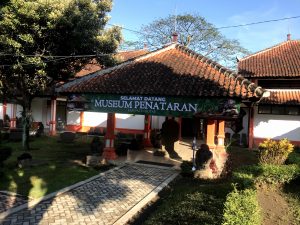
The Penataran Museum is located on the northern side of Blitar Regency, specifically on Penataran Main Road, Penataran Village, Nglegok Subdistrict, within the same area as the Penataran Temple. The collections at the Penataran Museum are dominated by historical artifacts such as statues, inscriptions, temple reliefs, as well as some historical artifacts like Chinese coins, traditional kitchen tools, and traditional transportation tools. Among the numerous collections at the Penataran Museum, there are several standout pieces, including:
1. The Ganesha Statue or Kinewu Inscription

The Ganesha Statue depicts a figure with a human-like body, four arms, and an elephant head, serving as a medium of worship during the Hindu-Buddhist kingdom era in Indonesia. The Ganesha statue collection at the Penataran Museum is fully depicted sitting in the utkutukasna posture on a square-shaped base with two layers, adorned with lotus flowers (padma), wearing a krida crown, with the right hand holding a patta (bowl), the right rear hand carrying a paracu (axe), and the left rear hand holding an aksamala (rosary). The decorations on this Ganesha statue include kundala (earrings), hara (necklace), upawita (caste sash), keyura (shoulder strap), kankana (bracelet), udarabandha (belt), and padavalaya (anklet). On the back of the stele/back wall of the statue, there is an ancient Javanese inscription known as the Kinewu inscription. This inscription is dated 829 and uses ancient Javanese script and language. The inscription states the date as the 12th day of the bright half of the month of Margasima in the year 829, which corresponds to November 12, 907 CE. The rest of the inscription mentions that Sri Maharaja Rake Watu Kura Dyah Balitung Sri Iswara Kesawa Tamara Tungga granted Ratna (the village head) in the village of Kinewu a tax exemption due to complaints that he was no longer able to cultivate his rice fields.
2. Statue of Goddess DurgaDewi
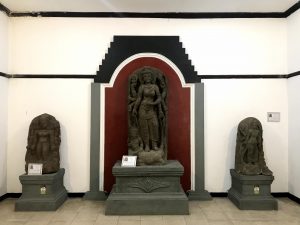
Durga Mahesasuramardini, or Dewi Durga, is another manifestation of Dewi Uma or Dewi Parwati, the wife of Dewa Siwa. During the Hindu-Buddhist kingdom era, the statue of Dewi Durga served as a medium or tool for worship. At the Penataran Museum, the statue of Goddess Durga has a complete appeal to be told, where the goddess is depicted as having eight hands, each carrying a weapon, namely a chakra, mace, bana (arrow), sangka, dhanu (oval bow), bull, padma flower, and the other hands pulling the hair of the giant Sura (bull). Dewi Durga herself stands atop Mahesasura, the bull incarnation of the giant, whom she defeated with the help of the gods. The goddess is characterized by curly hair, an oval face, and wearing a kiritamakuta crown and jewelry such as kundala (earrings), Upawita (caste rope), keruya (shoulder strap), udarabanda (belt), and wearing complete clothing.
The other collections at the Penataran Museum are quite diverse and very interesting to learn about their history and meaning. Don’t hesitate to visit the Penataran Museum, as this destination is managed by the Blitar Regency Government, so as of the writing of this article, there is no entrance fee—it’s free. Additionally, detailed descriptions are provided for each collection, and if you wish to obtain more comprehensive information, there are staff members available to accompany you during your visit to the Penataran Museum.