
Blitar Regency is one of the regions in East Java which is located on the south side with a distance of about 175 km from the city center of East Java, the closest international airport is Juanda Airport in Sidoarjo Regency with a distance of approximately 168 km from Blitar Regency, Juanda international airport to can be reached using several modes of public transportation such as buses and trains. Geographically, the Blitar Regency has an area of 1,589 km2 with complex natural conditions. On the north side are two mountains, namely Kelud and Buthak, which also form the boundaries with Kediri Regency and Malang Regency. The south side of Blitar has beaches and seas directly adjacent to the Indian Ocean. These geographical conditions impact various aspects of life in Blitar Regency, including sociocultural aspects.
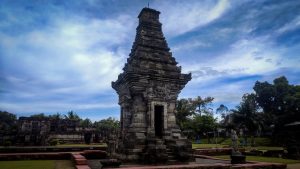
The people of Blitar Regency and its culture have been influenced by several significant kingdoms on the island of Java, such as the Kadiri, Singhasari, and Majapahit kingdoms. This can be seen from various relics in the form of cultural heritage objects commonly found in the Blitar Regency. In 2025, 653 suspected cultural heritage objects were recorded at the Blitar Regency Culture and Tourism Office as temples, sites, inscriptions, buildings, and ruins of cultural heritage objects. The number of cultural heritage objects in the Blitar Regency is a fascinating historical wealth to know and visit. Among the many cultural heritage objects in Blitar is the Penataran Temple, which is located on the side of the north Blitar Regency, precisely in Penataran Village, Nglegok district.
Penataran temple is also called Palah, and it is the grandest and most expansive temple in East Java Province. According to some sources, the Penataran temple is estimated to have been built in several periods. Construction was initiated by King Srengga of the Kadiri kingdom from 1200 AD until 1415 AD by the reign of Wikramawardhana of the Majapahit kingdom. Penataran temple functions as a place of worship ceremonies to ward off the dangers caused by Mount Kelud, which often erupts and damages settlements and agriculture. The Penataran temple complex stands on an area of 12,946 square meters, which is divided into several parts/buildings, including :
Front Yard

The front yard is characterized by two Dwarapala statues that have the year 1232 Saka, or 1310 AD. The Dwarapala statue is a door guardian depicted with a demonic figure that has typical decorations.
Bale Agung

This Bale Agung building probably functions for the priests’ deliberations. It measures 37 meters long, 18.84 meters wide, and 1.44 meters high and is surrounded by dragon carvings with dragon snake heads on the right and left of the building.
Terrace pavilion
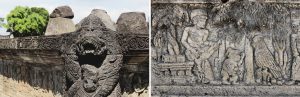
It is a building almost entirely made of stone. This building measures 29.05 meters long, 9.22 meters wide, and 1.5 meters high. This building is dated 1927 saka or 1375 AD, found in the relief carvings on the eastern wall of the terrace pavilion building. The other relief carvings tell many stories that have not been interpreted with certainty, including the story of Bubhuksah, Gagang Aking, Sang Setyawan, and Sri Tanjung. Terrace pavilion is also surrounded by dragon carvings with heads poking up between the pillars of building.
Candra Sengkala Temple
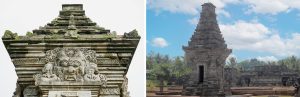
Candra Sengkala temple is often called Brawijaya temple or Ganesha because there is a Ganesha statue inside. The temple is made of andesite stone, dating back to 1291 saka or 1369 AD. This temple has a small room inside the door on the west side of the temple. In the small room is a Ganesha statue in a sitting position, padmasana, with a human characteristics elephant head, pot-bellied and sitting cross-legged. The Ganesha statue is a symbol of knowledge, wisdom, and the removal of obstacles. At the top of the room is a relief of Surya Majapahit, a symbol of the Majapahit kingdom. Another decoration on the Candra Sengkala temple building is the giant head of kala found on several sides, which scare away evil spirits so they do not dare enter the temple complex.
Main Temple

The main temple consists of three terraces with a total 7 height of 19 meters. The first terrace is surrounded by walls with reliefs telling the Ramayana story, which can be read from the northwest corner. The second terrace is covered with reliefs telling the story of Kresnayana. The third terrace has statues of winged lions and winged dragons carved into the walls.
Palah inscription
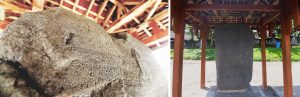
The Penataran temple complex also has a Palah inscription south of the main temple. It is significant, contains ancient Javanese writing, and dates from 1119 Saka or 1197 AD. It is known that the inscription was made at the command of King Srengga/Kertajaya of the Kadiri kingdom.